TL;DR
- Preparing for
labor and delivery is mostly decision-making: where you'll give birth, who's with you, how you plan to cope, and what you want in the first hour after birth.
- Labor usually starts gradually. Lightening, the mucus plug, and water breaking are common early signs, but what matters is regular contractions, along with rest and hydration.
- The first stage is the long one, about 12 to 19 hours, and longer for a first baby.
- At our birth center in Corona, you can move, eat, drink, use the tub, and keep the people you chose beside you the whole time.
- Most birth center transfers happen calmly and by car, for slow progress or exhaustion rather than emergencies.
Introduction
Speak to Us Today
The Signs That Labor Is Starting
Labor tends to announce itself over hours or days, not in one cinematic moment.
Womenshealth.gov lists the common signals as lightening (the baby settling lower in your pelvis), losing the mucus plug, your water breaking, and contractions.
A burst of energy to cook or clean, often called nesting, shows up for some people too.
The sign that carries the most information is the pattern of your contractions:
- True labor contractions come at regular intervals, get closer together, last about 60 to 90 seconds, and continue when you rest or change position, per
ACOG.
- Braxton Hicks have no steady pattern, often ease off when you walk, rest, or drink water, and don't build in strength.
- Your water breaking can happen before contractions start or well into labor. Note the time and the color of the fluid, and call us.
- Losing the mucus plug may happen days ahead of labor or right as it begins.
Families call us about the mucus plug most often, and it's rarely the sign to come in. Steady contractions are.
For a fuller walk-through of this stretch of pregnancy, our
Third Trimester Pregnancy and Signs of Labor guide covers what's normal and what warrants a call.
The Stages of Labor, Explained
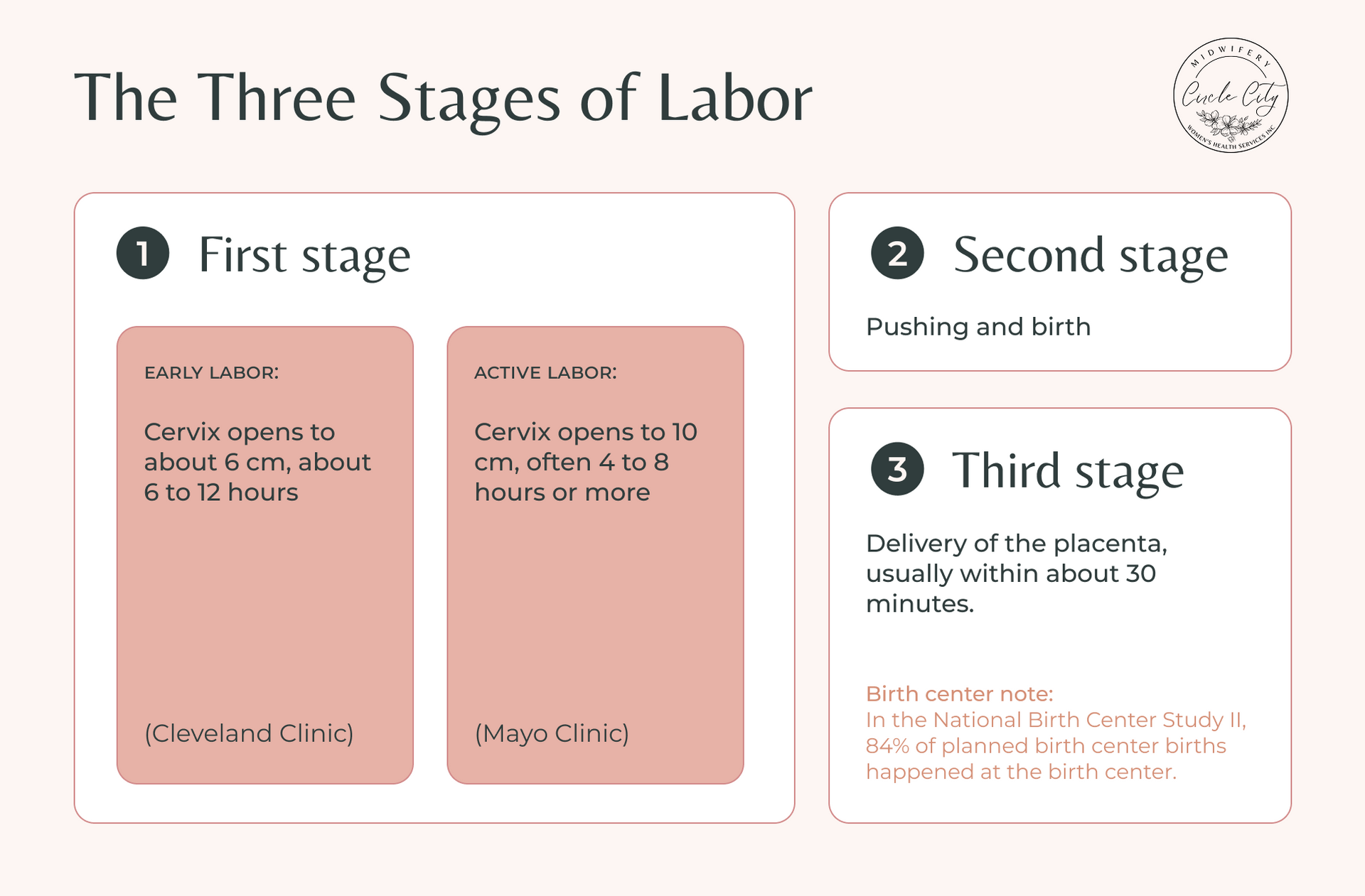
Labor is divided into three
stages:
- The first stage (contractions that thin and open the cervix)
- The second stage (pushing and birth), and the
- Third stage (delivery of the placenta)
Knowing which stage you're in changes what's useful, which is why we talk about it at prenatal visits rather than on the phone at 2 a.m.
Total labor often lasts 12 to 24 hours for a first birth and 8 to 10 hours for later births. Though early labor isn't predictable: it can stop and start for a day. Both sentences describe many of the births we attend, but neither describes all of them.
What to Expect When You Arrive at Circle City Midwifery
When you arrive at our birth center at 1353 Old Temescal Rd, Suite 103, we settle you into your suite first and do the clinical part around you. We check your vitals and listen to your baby's heart rate; we talk through how your contractions have been going, and we offer a cervical exam that you're free to decline.
After that, the room is yours:
- Move, walk, rock, shower, or get in the tub whenever you want.
- Eat and drink during labor instead of living on ice chips.
- Keep your partner, your mother, your doula, and your older children with you.
- Dim the lights, play your own music, and sleep between contractions if you can.
We use intermittent monitoring, so we check your baby's heart rate regularly without tethering you to a bed. Our
birth care center in Corona page walks through the suites and the equipment we keep on hand.
Planning your birth with us?
We'll walk you through the space and answer the questions you haven't thought of yet.
Comfort Measures and Support During Labor
Comfort in labor comes from having options you've practiced, and from changing them often. Most of what works is physical and unglamorous. We bring the tools; before the day, try a few so they feel familiar.
- Water. Warm immersion or a shower, often the most popular request in active labor.
- Position changes. Hands and knees, side-lying, standing, the birth ball, the squat bar.
- Counterpressure. A partner applies firm pressure to the lower back or hips during contractions.
- Breath and voice. Low, slow sounds. Pitch tends to drop as labor progresses, which is normal.
- Food, fluids, and rest. Labor is physical work, and eating supports it.
- Your people.
A calm room and familiar voices do more than most equipment.
Partners usually ask us what their job is. It's short: keep the water bottle full, apply counterpressure where she asks, protect the quiet, and don't disappear to make phone calls during active labor.
We don't offer epidurals or surgical birth. If an epidural is central to your plan, a hospital is the better setting.
Birth Choices in Corona lays out that comparison comprehensively.
What a Water Birth Looks Like at CCMW
Our suites have deep tubs large enough for you and your partner, and many families use them for hours during
water birth labor. Warm water takes weight off your back and hips and makes it easier to change positions.
ACOG reports that immersion during the first stage of labor may shorten labor and reduce the need for pain medication, and considers it appropriate for healthy people with uncomplicated pregnancies between 37 and 41 weeks.
What tends to surprise people:
- Your midwife monitors your baby's heart rate while you're in the tub.
- You can get out and back in as often as you like.
- If anything changes clinically, your midwife may ask you to leave the tub; that request is to keep a close eye on you.
Our
water birth services
page covers the practical details, and
Everything You Need to Know about water birth goes deeper on benefits and considerations.
Curious whether water birth fits your plan?
The Role of Your Midwife Throughout Delivery
Your midwife stays with you throughout the delivery. That's the clearest difference between our model and a shift-based unit, and it is also what families tell us they remember most. The same small team you saw at prenatal visits is the team listening to your baby's heartbeat at 3 a.m.
Throughout your labor, your midwife does several things at once: monitors your baby's heart rate and your vitals, watches how labor is progressing, suggests position changes, manages bleeding after birth, examines your newborn, and keeps you informed so you can make decisions.
Elizabeth Uppuluri, CNM, WHNP-BC, and Aki Shishido, CNM, IBCLC, are both certified nurse midwives, and Aki is also an international board-certified lactation consultant, which matters in the first hour when your baby is learning to latch.
Our guide to what a midwife does,
from Prenatal Care to Postpartum, covers the full scope of care throughout pregnancy.
What Happens Right After Birth
After the birth, your baby goes straight onto your chest. Skin-to-skin helps regulate temperature and stabilize heart rate and breathing.
A few things happen in that first hour:
- Delayed cord clamping.
ACOG recommends waiting 30 to 60 seconds for vigorous term infants, which raises hemoglobin at birth and improves iron stores in the first months.
- The third stage. The placenta is delivered, usually within about half an hour, and your midwife checks it and assesses any bleeding.
- First latch. We help you with positioning, and we keep helping after you go home.
- Repair if needed. Any tearing is assessed and repaired in your suite.
- Going home.
Most families go home within several hours, with a follow-up visit scheduled.
The weeks afterward deserve as much planning as the birth itself. Our
postpartum care service and our
Postpartum Tips article are worth reading before the baby arrives, while you still have quiet evenings.
When a Hospital Transfer Might Be Needed
Most of these end the same way: a car ride, a midwife who has already called ahead, and a tired parent rather than a frightened one. That's what a typical birth center transfer looks like, and it's worth picturing accurately because most people picture an ambulance.
In the
National Birth Center Study II, which followed 15,574 women planning to give birth at birth centers across 79 U.S. centers, 84% gave birth at the birth center. About 12% transferred to a hospital during labor, and under 1% of the full sample transferred for emergency reasons. The most common reasons for non-emergency transfer were stalled labor or a parent needing rest and pain relief.
Reasons we might recommend transfer include:
- Labor that stops progressing over a long stretch
- A desire for an epidural once labor is underway
- Blood pressure changes, bleeding, or a fever
- A fetal heart rate pattern we want continuous monitoring for
- Meconium or a baby who needs added support after birth
Your midwife stays in contact through the handoff. Transfer is the plan working as designed, which is why we discuss it at a prenatal visit rather than leaving it as a surprise.
Preparing for Your Labor and Delivery at Circle City Midwifery
Most preparation that pays off comes from decisions and rehearsal. Gear is the easy part, and in our experience, people over-invest in it. Here's what we'd put on the list in your final weeks:
- Write a birth plan and keep it to one page.
Crafting Your Birthing Journey walks through the real choices you face.
- Take a childbirth class and practice two or three comfort techniques with your partner.
- Pack the bag by 36 weeks using our
Birth Checklist.
- Install the car seat early. What most often derails a calm departure isn't labor; it's a car seat still in its box.
- Choose your pediatrician and line up help for the first two weeks at home.
- Save our number and know who you're calling at 3 a.m.
- Keep prenatal visits. Weekly
prenatal care
in the last month helps us catch small things early.
Our
Pregnancy Month by Month guide is the one we send to people who are still in the first trimester and already planning. Reading ahead costs nothing.
How Can Circle City Midwifery Ease Your Journey
Book a consultation, come see the suites, and ask the questions you've been saving.
We'll talk through your plan, your options for comfort and water immersion, and what happens if the plan changes.
If you're already a client, bring your birth plan draft to your next prenatal visit, and we'll go through it line by line.
Frequently Asked Questions
How do I know when to go to the birth center?
Call your midwife when contractions have settled into a steady pattern, are getting stronger, and continue through rest and hydration. Also call if your water breaks, if you notice bleeding, or if your baby's movements change. We'd rather talk to you early and tell you to sleep than have you wait and wonder.
What early labor signs should I watch for?
Common early signals include lightening as your baby settles lower, losing the mucus plug, a clear or pink increase in discharge, backache, loose stools, and contractions that come and go. According to womenshealth.gov, these can appear days before labor or right as it starts. Call your provider about any of them.
How long does labor usually last?
Average labor lasts 12 to 24 hours for a first birth and 8 to 10 hours for later births, with the first stage taking up most of that time. Your own labor may run shorter or longer. Length alone doesn't tell your midwife whether labor is going well.
Can I have a water birth at Circle City Midwifery?
We offer water immersion during labor in the deep tubs in each suite. ACOG supports immersion during the first stage of labor for healthy, full-term, uncomplicated pregnancies and recommends that birth occur on land. We'll review that guidance with you during pregnancy so you can make an informed choice.
What happens if I need a hospital during labor?
Your midwife arranges the transfer, calls ahead, and shares your chart with the receiving team. Most transfers are non-urgent, often for a labor that has stalled or a request for an epidural, and most happen by car. Your midwife stays in contact with you through the handoff.
How early should I pack for the birth center?
Have your bag packed by about 36 weeks and the car seat installed before then. Include your ID and paperwork, a long robe or two-piece outfit, snacks and drinks, a phone charger, a going-home outfit for the baby, and anything that makes a room feel like yours.
This article is educational and isn't medical advice. Talk with your midwife or healthcare provider about your own pregnancy, symptoms, and birth options.